



The Fundamental Principles of Education in Sri Lanka
The 1978 Constitution of Sri Lanka recognizes the universal right to education and sets out ambitious guidelines for the development of the national education system.
It establishes education as a strategic pillar of economic and social progress, intended to build a more prosperous, fairer, and more harmonious society.
This constitutional framework is based on several fundamental principles: :
The acquisition of knowledge and skills, in order to equip every citizen with the intellectual and practical tools needed for lasting integration into economic and social life.
The integral development of the person, promoting the intellectual, moral, spiritual, and physical fulfillment of each individual.
The democratization of education and equality of opportunity, ensuring fair access to education for all, regardless of social background, gender, religion, or geographic location..
Preserving and promoting cultural and environmental heritage, ensuring the transmission of Sri Lankan traditions, values, and national identity.
Strengthening social cohesion by promoting mutual respect, dialogue, and unity among the country's different ethnic and religious communities.
An essential path out of poverty
Education is, above all, a major lever in the fight against poverty.
By enabling each individual to acquire:
knowledge,
skills, and
intellectual autonomy.
The school system in Sri Lanka
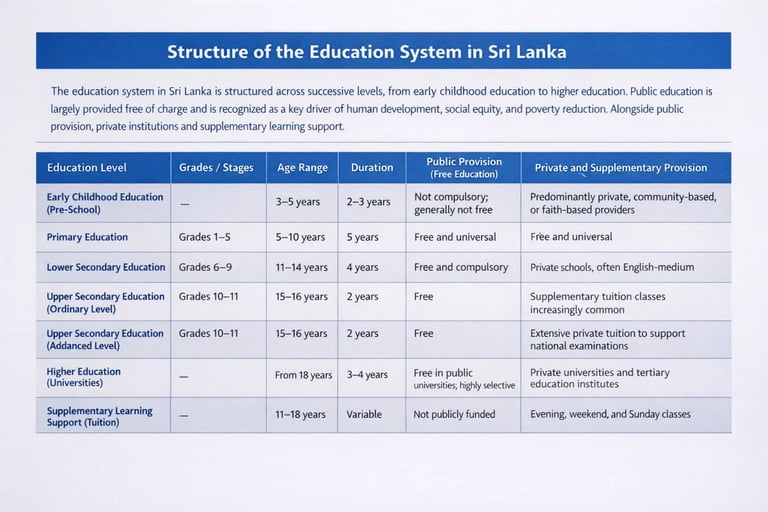
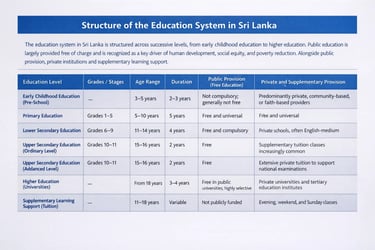
The education system in Sri Lanka is organized into several progressive levels, ranging from early childhood to higher education.
Public education is largely free and considered a key tool for social development and poverty reduction, although private education and supplementary courses also play an important role.
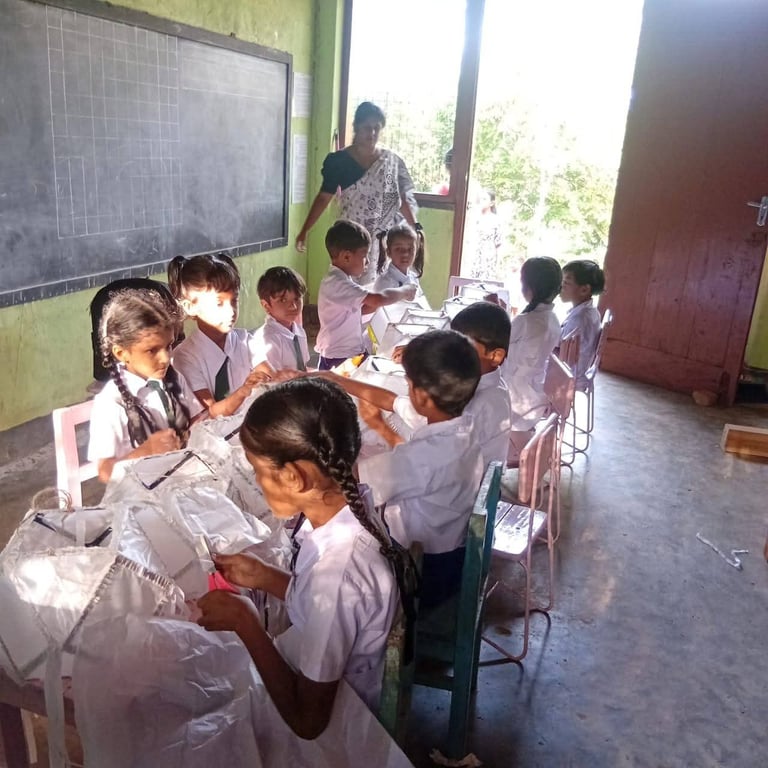




The economic crisis continues to hit Sri Lanka
UNICEF reports that 4.8 million children (50%) have been affected by:
two years of interrupted learning due to COVID,
lack of resources,
and now, the disaster caused by Cyclone Ditwah (November 2025).


Preschool
Preschool is for children aged 3 to 5.
It is not part of compulsory education and is mainly provided by private, community, or religious institutions.
At this level, education is not generally free, although some NGOs or local initiatives offer low-cost programs.
Preschool focuses primarily on the social, emotional, and linguistic development of the child, in order to facilitate their entry into primary school.
Primary school
Primary education begins at around age 5 and continues until age 10, covering grades 1 through 5 (duration: 5 years).
Public elementary school is free.
There are also private elementary schools, which often charge tuition and sometimes offer instruction in English.
This level focuses on the acquisition of fundamental skills: reading, writing, mathematics, and the basics of social life.
Middle school (secondary education)
Secondary education is divided into two cycles:
Junior secondary education :
Ages 11 to 14
Grades 6 to 9
Duration: 4 years
Public education remains free, with regular assessments.
Private lessons and academic support
In Sri Lanka, it is very common for students to take private tutoring classes, known as tuition classes.
These classes are paid for.
They often take place in the evening, on Saturdays, or on Sundays.
They are mainly for middle school students preparing for O-Level and A-Level exams.
These classes aim to reinforce knowledge, improve academic performance, and increase the chances of getting into university, especially for students from modest backgrounds seeking social advancement through education.
University and higher education
Admission to university is granted after passing A-Levels, generally at the age of 18.
Public universities are free, but highly selective.
As places are limited, many students turn to private universities or higher education institutions, which charge tuition fees.
University studies generally last 3 to 4 years, depending on the course.
Higher education is a key step toward skilled employment and represents a real way out of poverty for many young people.








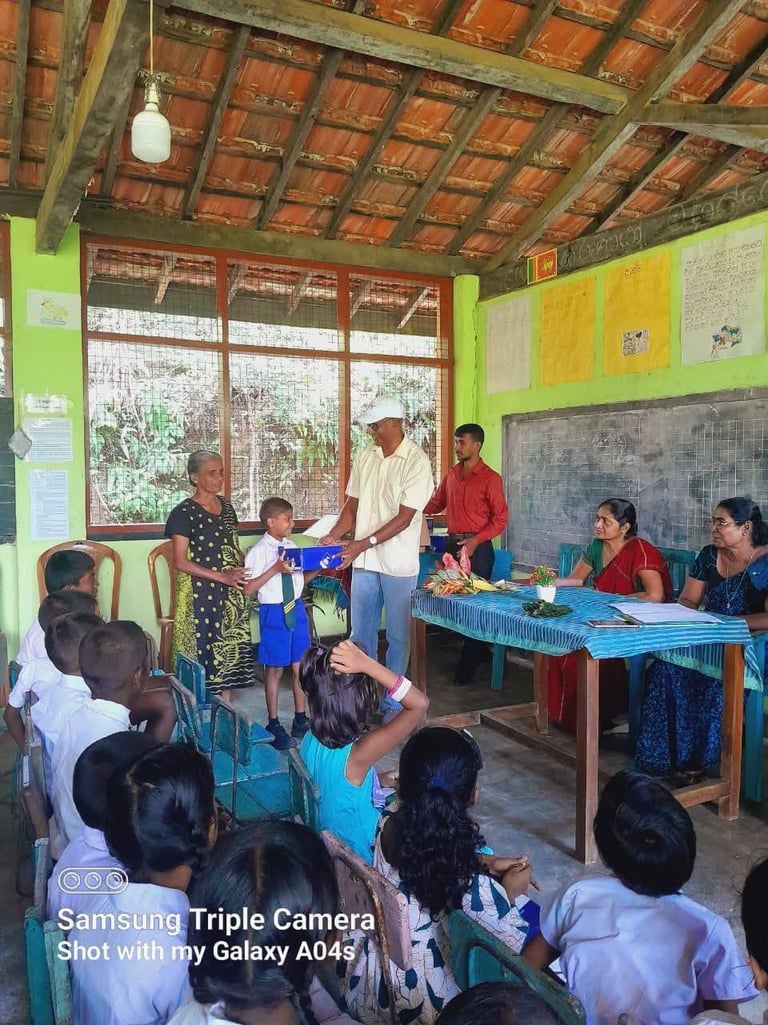
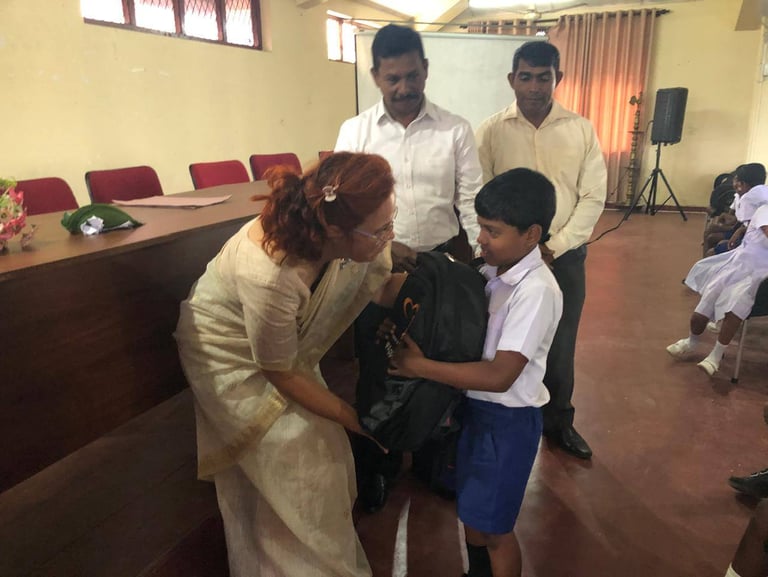
We sponsor over a hundred children who will be monitored throughout their school and university education to ensure the success of their support.
Our section
MUTUAL AID & HUMANITARIAN Programme


strengthens our support by offering concrete solutions aimed at improving families' living conditions and facilitating children's schooling, in order to provide them with an environment conducive to their development and academic success.
Our mission
EMPLOYMENT &
BUSINESS Programme


Open the doors to the world of work and offer an additional chance of success thanks to our apprenticeship support.
***
You can support us with a monthly donation, which enables us to build and plan long-term support for a child, giving them the means to escape poverty for good.
It provides the means to:
build a stable professional future,
improve living conditions, and
break the intergenerational cycle of poverty.
It also plays a central role in the overall development of children, ensuring their intellectual, moral, spiritual, and physical development, while promoting equality between girls and boys, which is essential for inclusive economic development.
Senior Secondary School
Ages 15 to 18
Grades 10 to 13
Prepares students for national exams:
O-Level (Ordinary Level) at around age 16
A-Level (Advanced Level) at around age 18
Education is still free in public schools, but academic pressure is high.
Contact :
FRANCE TO SRI LANKA
54 Montée des Ecureuils
73410 LA BIOLLE
SAVOIE - FRANCE
© 2025. All rights reserved.
FRANCE TO SRI LANKA et FRIENDS TO SRI LANKA sont des marques déposées.

Bank : CREDIT MUTUEL
Registration number in the national register of associations : W732011373
SIREN : 924 484 124 00012
Association recognized as being of general interest according to DGFIP ruling of February 6, 2024
Association eligible under the French “Coluche Law” (provisions of 1 ter. of Article 200 of the General Tax Code) allowing a tax reduction of 75% for donations up to €1,000 for individuals residing in France.
_________________________________________________________